





Most organizations follow a compliance-centric approach to cybersecurity. Policies are documented, training modules are completed, and audits are passed. Yet breaches continue to occur because the real problem is in the decisions employees make when confronted with real-world risks. 22% of breaches are caused by credential abuse, which remains the most common vector.
Compliance programs measure completion, not behavior. They rarely influence what people actually do when faced with a risky email, a suspicious link, or a request to share sensitive data. This gap between knowing and doing is where many security programs quietly fail. Attackers exploit the gap between what employees learned in a module and what they actually do under pressure. It results in organizations that are fully compliant on paper but vulnerable in practice.
They are adopting a fundamentally different engagement model that operates continuously, responds to real signals, and reaches employees at the exact moment a risk occurs. They are judiciously using micro-nudges to influence employees’ behaviour at the moment of risk, creating a human firewall for greater resilience.
This article explores why the traditional compliance-checkbox model falls short and how small, well-timed micro-nudges can turn employees into an active line of defense.
The Shortcomings of Compliance Checkbox Approach
Many organizations treat security compliance as a box-ticking exercise with policies signed, modules completed, and audits passed. The compliance checkbox approach measures participation, not mindset or behaviour change. Without reinforcing secure habits in daily workflows, compliance programs create paperwork, not protection.
Compliance Becomes The Goal Instead Of The Outcome
Regulatory frameworks such as SOC 2, ISO 27001, and HIPAA require documented evidence of the organization’s security initiatives, including employee training. Over time, the organization’s objective becomes creating a security baseline and ensuring that employees are trained to fulfill a legal obligation. They focus on maintaining documentation to comply with certification requirements. However, in doing so, organizations quietly decoupled security initiatives from the outcomes they were supposed to generate.
Organizations may be fully compliant on paper while deficient in real-world attack situations because the security program was calibrated to satisfy an audit, not to change what people actually do.
Employee Training Alone Doesn’t Drive Behaviour Change
Employee training completion rate serves as the primary KPI, even though it doesn’t offer any insight into whether those employees are making better security decisions. Most training happens far away from the actual moment of risk. Learning about MFA in a classroom doesn’t help when a user is tempted to bypass it during a busy login.
Even well-designed security training faces a challenge that has nothing to do with content quality; instead, it’s about timing. There’s a gap between when an employee learns something and when they need to apply the learning. That gap is where most security behavior breaks down. The knowledge doesn’t transfer reliably under real-world pressure, especially when the employee is busy, distracted, or operating on autopilot.
Creates Cybersecurity Silos
A compliance-centric approach to risk management tends to reinforce a damaging organizational dynamic. Security becomes the sole responsibility of the security team, while everyone else fulfills their obligation by completing a course. This separation between those who own security and those who are merely trained on it creates silos that are difficult to break down. When an incident occurs, the responsibility gap becomes immediately apparent as everyone rushes to the security team for remediation.
With threats continually evolving and the attack surface expanding, a compliance-centric cybersecurity approach is no longer sufficient to protect against emerging vulnerabilities and risks. A “checkbox” approach satisfies auditors, but it fails to stop attackers who exploit the few seconds available between stimulus and decision.
Using Nudges to Build A Strong Cybersecurity Culture
Nudge theory, popularized by behavioral economists Richard Thaler and Cass Sunstein, describes how small, well-timed prompts can guide better decision-making without restricting freedom. Behavior is shaped by the environment in which decisions are made, and small changes to that environment can have outsized effects on what people actually do.
Nudge Theory Meets Cybersecurity
Nudge theory application in cybersecurity means shifting to a model where your employees receive real-time, frictionless guidance that makes secure behavior a part of their work routine. Instead of receiving instructions to address security flaws, they receive a brief, friendly message explaining the specific risk and offering a resolution to implement it. Instead of a policy reminder, they get micro-training tied to something they actually just did.
The compliance framework outlines the rules. In contrast, the nudge framework makes following the rules easy, immediate, and rewarding.
What Distinguishes Nudge From Noise?
Not every security prompt qualifies as a nudge in the cybersecurity context. A nudge is a deliberate, well-timed prompt that guides users toward a decision or desired behavior without overwhelming them. Noise, in contrast, is any security message that interrupts work without context or value. It may be frequent, generic, or poorly timed. The difference lies in how the message influences behavior.
Key characteristics that separate nudge from noise are as follows.
Contextual
A nudge is triggered by a specific user action or risk scenario, such as uploading sensitive data or clicking an unknown link. It is contextually appropriate and fits in the user journey. Noise is generic communication sent without context, like blanket reminders that employees ignore and forget.
Timing
A nudge appears at the precise moment a decision is to be made, shaping behavior in real time. Noise shows up at the wrong time, interrupting rather than assisting. It arrives before or after the moment of risk, making it easy to dismiss because it doesn’t align with the user’s immediate task.
Actionable inputs
A nudge clearly guides the user to take action, whether to verify the recipient, confirm the file classification, or pause before clicking. Noise often delivers information without a clear action, leaving employees unsure how to respond. It forces the user to filter, ignore, or disengage.
Non-invasive
Effective nudges are short, focused, and embedded within the workflow. They guide behavior change without impacting productivity. Noise is intrusive, creating friction and leading employees to ignore security messages altogether.
Behavior-focused
A nudge aims to shape everyday decisions and reinforce secure habits. It drives measurable behavior change. Noise tends to reference policies or compliance rules, which may inform employees but rarely influence their real-time behavior.
Effective security programs focus on delivering the right prompt at the right moment so employees can act securely without interrupting their work. Nudge helps lay the behavioral foundation for a strong organizational security culture.
How Micro-Nudges Create a “Human Firewall”
Network security has firewalls. Cloud has configuration controls. Identity has MFA and zero-trust frameworks. The organization spends billions on technical controls while underinvesting in the human layer that sophisticated adversaries exploit most reliably.
Social engineering, weak credentials, phishing, and insider risk all exploit human weaknesses to gain network access through manipulation. Human behavior, which is the root cause behind 60% of breaches, has largely been addressed with training modules with little impact. Use high-impact security micro-nudges to create an effective human firewall for greater resilience.
Common High-Impact Security Nudges That Builds Human Firewall
Though the term “human firewall” has been used in security circles for years, most programs are really just building human awareness. When designed well, micro-nudges reinforce secure habits without disrupting productivity and gradually strengthening the organization’s human firewall.
Some common high-impact security nudges that you can leverage are as follows.
Device & endpoint security
When a critical vulnerability is identified on an employee’s device, a timely patch reminder guides them through the update process before attackers can exploit the exposure. It helps reduce the risk window without relying on employees to monitor updates themselves.
Missing disk encryption
When disk encryption is missing or has lapsed on a device, a prompt guides the employee to enable it immediately, preventing a lost or stolen device from automatically leading to a data breach.
Identity & access
When multifactor authentication (MFA) is absent or disabled on an account, a direct enrollment nudge makes enabling it a simple, guided action, removing the friction that causes employees to defer this critical protection.
Phishing & social engineering
When an employee interacts with a suspicious link, attachment, or communication, real-time nudge delivers relevant guidance at the exact moment the risk occurs. A prompt reminds the user to verify the sender and avoid clicking unfamiliar links or attachments. This nudge reduces phishing risk by encouraging a quick pause before taking action.
Password strength indicator
Integrating dynamic strength meters into password creation screens makes hidden risk immediately visible. When users create weak credentials, the indicator turns red, guiding them to create stronger, unique passwords. As users type, the indicator changes from red to green based on password strength, providing real-time feedback.
Similarly, when users try to reuse previously used passwords, a gentle nudge reminds them of those passwords. It encourages them to create a stronger, unique password. Over time, this builds better credential hygiene across the organization.
Compliance & policy gaps
When an employee’s behavior indicates a knowledge or awareness gap, a short, targeted micro-training is delivered at the moment it’s most relevant. When an action taken by an employee carries a policy implication, a prompt draws an explicit connection between their behavior and the relevant obligation in real time.
Shadow IT use
When an unauthorized application or unsanctioned AI tool is detected in use, a nudge explains the associated risk and directs the employee toward an approved alternative. The nudge addresses the risky behavior before it creates compliance issues or security exposure.
When a legacy or high-risk application is found on a device, employees are prompted to remove it with a clear, step-by-step path, eliminating the vulnerability without requiring a support ticket or waiting for IT intervention.
Sensitive Data Sharing Alert
If an employee attempts to send files containing confidential information outside the organization, a contextual prompt asks them to confirm the recipient and data classification. This helps prevent accidental data leaks and reinforces awareness of sensitive information.
Introducing Amplifier’s Behavior Loop
Behavior Loop is Amplifier’s pre-built artificial intelligence (AI)-enabled solution that delivers micro-nudges tied to real employee risk signals.
Amplifier’s Behaviour Loop process signals from your existing security stack, such as identity tools, endpoint management, vulnerability scanners, and collaboration platforms. Based on the type of risk signal, Amplifier AI agent Ampy delivers a targeted nudge through your existing communication channels, such as Slack, Teams, and email, with context about the risk and a guided resolution path.
For example, KnowBe4/Proofpoint phishing signals anomalous activity. Amplifier AI agent Ampy delivers a micro-nudge in the form of a short 30-second training module and tracks acknowledgement.
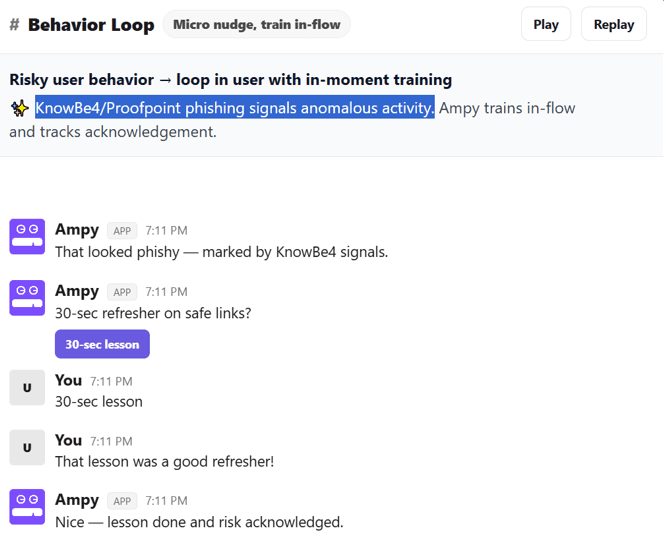
Behavior Loop fundamentally differs from traditional training programs. Content is never pushed because a deadline is approaching or a compliance schedule says it’s time. It is delivered because a device signal indicates that the employee would benefit from this specific guidance.
That shift from calendar-driven to signal-driven delivery changes employees’ perspective. They receive information that’s directly relevant to something happening in their actual work environment. It’s tied to action, not just awareness, so it reinforces the behavior change in a way that module-based training simply cannot.
In the Behavior Loop, nudges and micro-training are delivered inside the tools employees already use. Security guidance feels like helpful information, not a corporate mandate that needs to be complied with. Employees become willing participants in security initiatives.
Turning Security Nudges into Lasting Change
Turning employees into a “Human Firewall” isn’t about making them security experts; it’s about making security an instinct. When secure behavior becomes the “path of least resistance,” the entire organization becomes more resilient.
Instead of being the “weakest link,” employees become active participants who can spot hidden objectives of a social engineering attempt that technical tools might miss. By resolving issues in the moment without negatively impacting productivity, the Behaviour Loop keeps the business moving while enhancing organizational resilience.
Are you ready to see how the Behaviour Loop can transform your organization? Book a demo with Amplifier Security today and start building your human firewall.
Latest Blogs
Related Blogs & News
Watch

