

Employees are creating AI agents faster than security teams can track who owns them. Plus, when device records disagree with each other, nobody notices until an incident occurs or an audit forces the question. Amplifier's newest release closes both of these gaps.
AI Agent Intent & Posture Management
Every AI agent gets an owner, a purpose, and a record that outlives the credential.
Employees are creating AI agents in local agent clients, low-code studios, copilots, and SaaS-native builders faster than security teams can establish who owns them or whether they still need to exist. Agent Intent & Posture Management (AIPM) gives every agent an owner, a stated purpose, and a record that outlives it: one engagement channel in Slack or Teams, one evidence trail.
AIPM runs a six-step motion for agents, similar to what the platform already runs for people:
Discover agents and confirm human ownership.
Validate each agent's purpose with the accountable human who created it.
Assess access and behavior against that declared intent.
Enrich findings with external threat intelligence.
Engage the owner to resolve findings in the flow of work.
Preserve evidence from onboarding through retirement.

The AI Agent inventory: every employee-created agent, its owner, and its attestation status in one list.
The owner declares what an agent is for. Amplifier checks the agent's observed access and behavior against that declaration, and any gap becomes a finding routed to a person, not a ticket queue. No inferred purpose, no credential-only offboarding, just a durable record that survives after the agent's access is revoked.
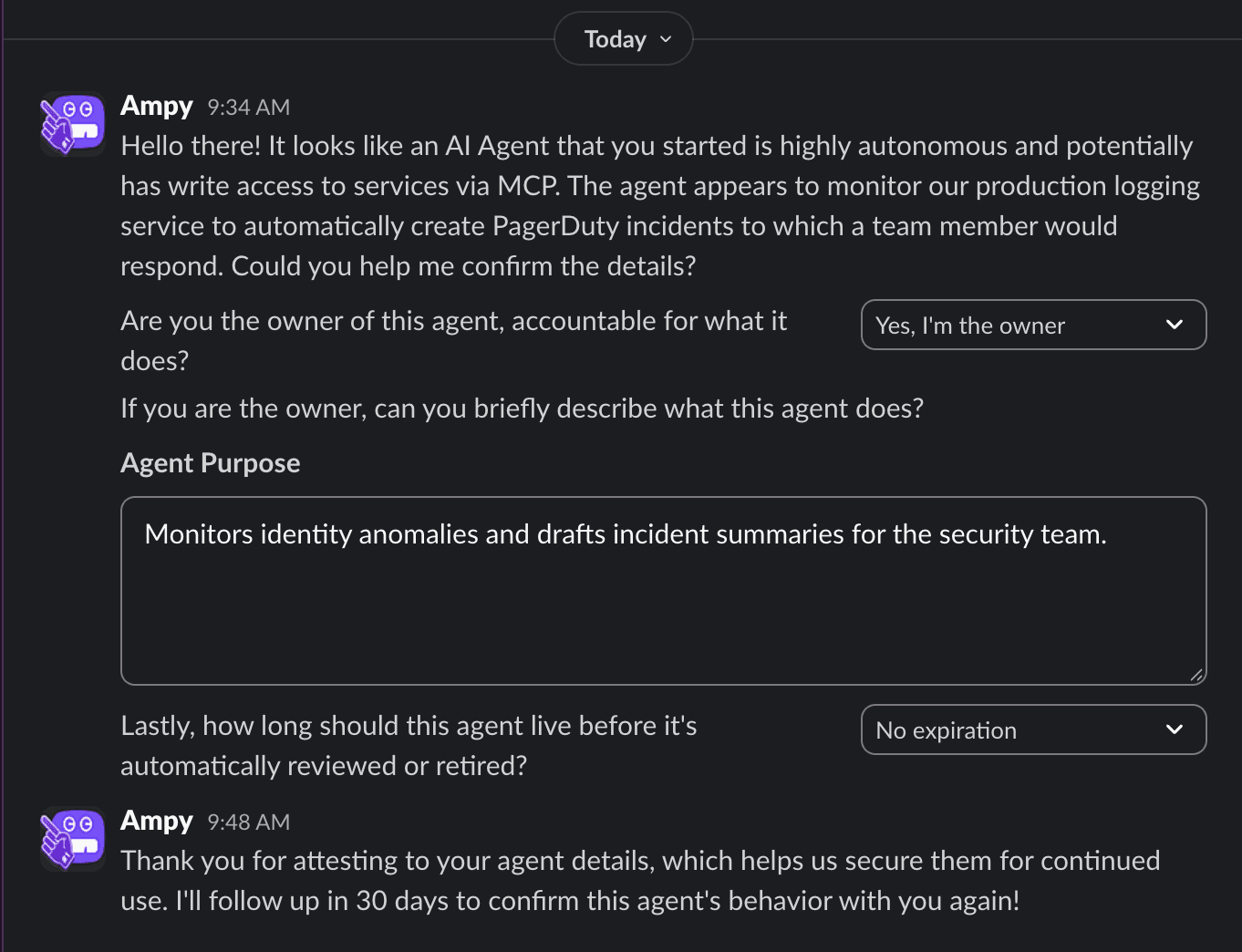
Ampy reaching the agent's creator directly in Slack or Teams to confirm ownership and stated purpose.
Resolve Device Ownership Conflicts
Device attribution breaks in a specific way: one system of record says an employee owns a device, another says someone else does, and nobody notices until an audit or an incident asks who had it. Amplifier now ships a dedicated engagement built for exactly that conflict. Setting it up takes minutes: you decide what happens when an employee confirms a device is theirs, and what happens when they say it isn't.

Confirm Device Ownership options in AI Agent Studio: drag it onto the canvas and configure both outcomes.
Conversational Intelligence Improvements
Amplifier’s AI security engineer, Ampy, now understands what an employee means, not just which button they click. Tell it "schedule this reboot for 6:30 tonight" and it schedules the reboot. Say "this was already done" and it closes things out. Ampy only offers actions that are already approved for that engagement, so it can’t go off script.

Free-text schedule resolution in Teams: no modal, no button hunt.
Why this release matters
Your AI workforce is growing faster than anyone's ability to track who's accountable for it, and your asset data probably disagrees with itself more than you’d like. This release puts a confirmed owner and a full lifecycle record behind every agent your employees create. Moreover, it resolves the device ownership conflicts that quietly undermine the foundation of your security program. Less time chasing down who owns what, more reducing risk with the evidence to prove it.
Frequently Asked Questions
What is AI Agent Intent & Posture Management?
AI Agent Intent & Posture Management gives every employee-created AI agent a confirmed owner, a declared purpose, and a lifecycle record that remains after its credentials are revoked. Amplifier compares the agent’s observed access and behavior with that stated intent, turns gaps into findings, and routes them to the accountable person in Slack or Teams.
How does Amplifier resolve conflicting device ownership records?
Amplifier uses a dedicated engagement to ask the employee whether a device belongs to them. Security teams configure what happens for either response, so confirmed devices can be reconciled and disputed ownership can follow the right workflow without waiting for an audit or incident to expose the mismatch.
How does Amplifier improve the employee experience during security engagements?
Amplifier lets employees resolve security issues through natural language conversations in Slack or Teams instead of forcing them through rigid forms, unfamiliar portals, or long button-driven workflows. Employees can explain what they need, schedule an approved action, or confirm that work is complete in their own words, while Ampy keeps every response within the security team’s approved options.
Latest Blogs
Related Blogs & News



Watch