

Endpoint Security Posture Management
Know every device,
who owns it, and
whether its controls
are running.
Apply Workforce Security to the laptops your employees use every day, and the EDR, MDM, and vulnerability tools you already run on them.
Amplifier verifies the controls you believe are running, attributes every device to an accountable owner, and engages that owner to close the gap on a schedule that works for them, inside the window security sets.
Security that respects the employee experience.
The Job It Does
Close endpoint gaps without losing productivity, or trust in the program
EDR detects and responds. ESPM identifies and protects. EDR hunts active threats in real time; ESPM continuously verifies that the controls you’re counting on, the EDR agent among them, are installed, active, and healthy. In NIST CSF terms, that’s Detect/Respond versus Identify/Protect. Neither replaces the other.

Which devices exist, and who owns them?
Amplifier reconciles fragmented endpoint, asset, and identity data into one attributed view, so an unattributed laptop stops being an unroutable finding.
Are the controls you believe are running installed, active, and healthy?
A continuous audit checks for disabled endpoint protection, missing or stale security software, unpatched applications with known CVEs, and unauthorized applications, including whether the EDR agent and MDM sensor themselves are installed and reporting.
Is the right person closing the gap?
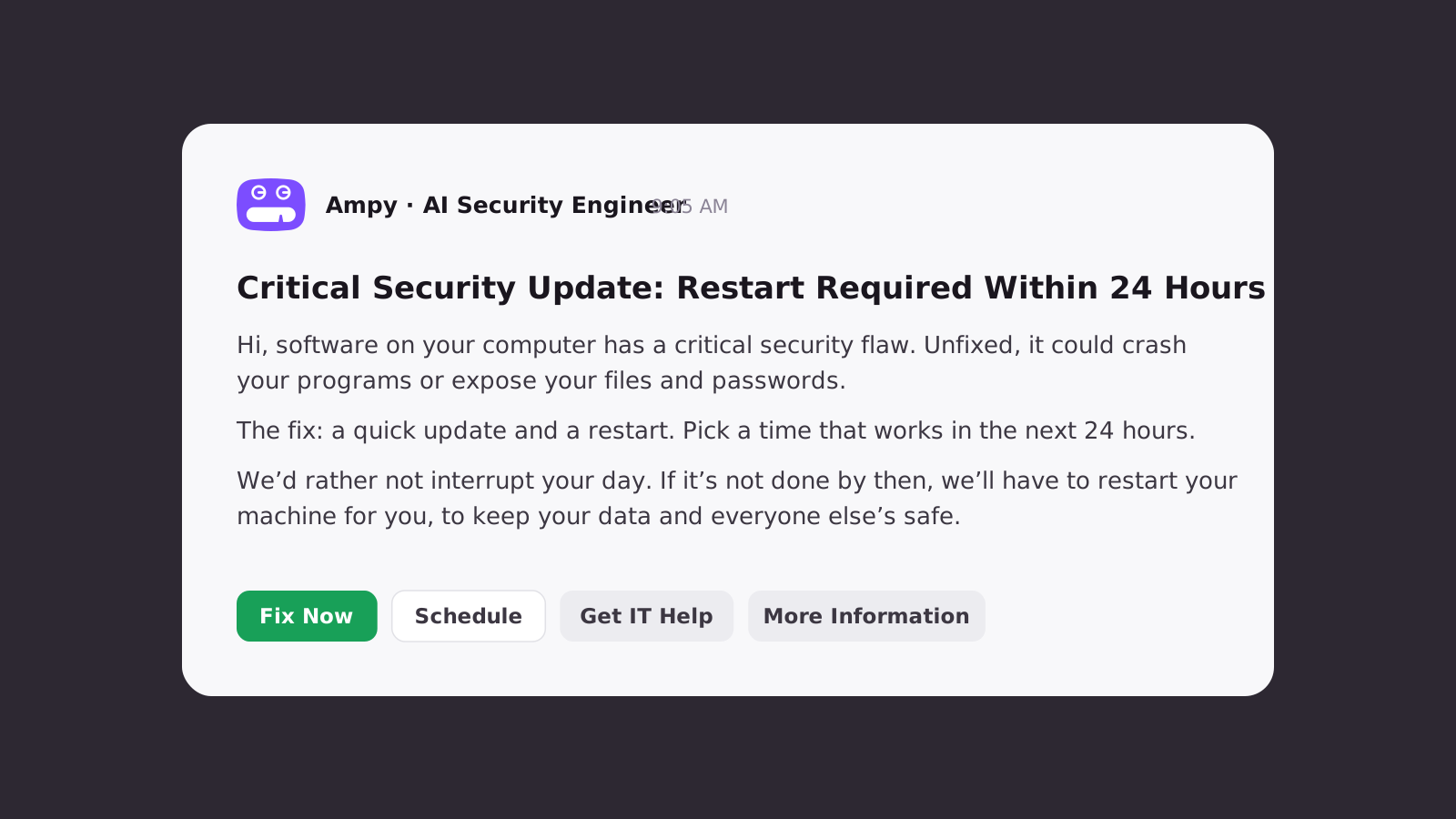
Ampy, the AI Security Engineer, routes the verified gap to the device owner in Slack or Teams, not a ticket queue. Security decides which findings become an employee request, which go to IT, and which stay internal.
Can you prove it?
The fix is verified complete before it’s recorded as closed, so security can show the board, auditors, and cyber insurers that exposure fell.
The Job It Does
Close endpoint gaps without losing productivity, or trust in the program
EDR detects and responds. ESPM identifies and protects. EDR hunts active threats in real time; ESPM continuously verifies that the controls you’re counting on, the EDR agent among them, are installed, active, and healthy. In NIST CSF terms, that’s Detect/Respond versus Identify/Protect. Neither replaces the other.
Which devices exist, and who owns them?
Amplifier reconciles fragmented endpoint, asset, and identity data into one attributed view, so an unattributed laptop stops being an unroutable finding.
Are the controls you believe are running installed, active, and healthy?
A continuous audit checks for disabled endpoint protection, missing or stale security software, unpatched applications with known CVEs, and unauthorized applications, including whether the EDR agent and MDM sensor themselves are installed and reporting.
Is the right person closing the gap?
Ampy, the AI Security Engineer, routes the verified gap to the device owner in Slack or Teams, not a ticket queue. Security decides which findings become an employee request, which go to IT, and which stay internal.
Can you prove it?
The fix is verified complete before it’s recorded as closed, so security can show the board, auditors, and cyber insurers that exposure fell.
How ESPM complements the controls you already run
How ESPM complements the controls you already run
Your EDR, MDM, and vulnerability scanner each do one job well, and each assumes a device state nobody continuously checks: that the agent installed last year is still active, that the laptop assigned to a name still belongs to that person, that the CVE flagged last quarter got closed. Security reconciles agent to device by hand. IT chases the stragglers. And when a fix does get forced on someone, it lands at the worst possible moment.
Your EDR, MDM, and vulnerability scanner each do one job well, and each assumes a device state nobody continuously checks: that the agent installed last year is still active, that the laptop assigned to a name still belongs to that person, that the CVE flagged last quarter got closed. Security reconciles agent to device by hand. IT chases the stragglers. And when a fix does get forced on someone, it lands at the worst possible moment.
EDR
ROLE IN THE WORKFLOW
Detects and responds to active threats in real time through tools such as CrowdStrike and Defender.
WHAT ESPM ADDS
Verifies the EDR agent itself is installed, active, and healthy.
MDM
ROLE IN THE WORKFLOW
Enrolls and configures devices through tools such as Intune and Jamf.
WHAT ESPM ADDS
Verifies enrollment and configuration hold over time, and routes drift to the device owner.
Vulnerability scanners
ROLE IN THE WORKFLOW
Scores and prioritizes CVEs.
WHAT ESPM ADDS
Closes the prioritized finding through an owner-scheduled action, verified complete.
No more chasing stragglers. No more fighting asset data quality by hand. ESPM closes the gap for security and IT, together.
How It Works
Know, act, prove, applied to every device
Amplifier connects continuous audit, accountable ownership, owner-scheduled action, and verified evidence in one workflow.

1. Audit every device’s controls, continuously
EDR agent, MDM sensor, patch status, and unauthorized applications.

2. Attribute every device to an accountable owner
Reconcile endpoint, asset, and identity data so every gap has a route.
3. Route the verified gap to that owner
Ampy reaches the right employee in Slack or Teams.
4. Let the owner pick the time
The employee chooses a moment inside the window security sets.
5. Verify the fix landed
Confirm completion against the device before recording it as closed.
6. Report the exposure reduction
Preserve the evidence for security, IT, auditors, and insurers.
How It Works
Know, act, prove, applied to every device
Amplifier connects continuous audit, accountable ownership, owner-scheduled action, and verified evidence in one workflow.
1. Audit every device’s controls, continuously
EDR agent, MDM sensor, patch status, and unauthorized applications.
2. Attribute every device to an accountable owner
Reconcile endpoint, asset, and identity data so every gap has a route.
3. Route the verified gap to that owner
Ampy reaches the right employee in Slack or Teams.
4. Let the owner pick the time
The employee chooses a moment inside the window security sets.
5. Verify the fix landed
Confirm completion against the device before recording it as closed.
6. Report the exposure reduction
Preserve the evidence for security, IT, auditors, and insurers.
SAMPLE CONVERSATION
“Your EDR agent has been off for 11 days. Turn it back on? One click.”
“Your EDR agent has been off for 11 days. Turn it back on? One click.”
Human Oversight
Amplifier verifies. Employees close the gap, on their schedule. Security keeps the SLA.
The audit surfaces a gap. Security decides whether it becomes an employee request, an IT ticket, or stays internal. For an employee request, Ampy engages the owner in Slack or Teams with one specific, explained ask, not a queue and not a silent enforcement. The owner picks a time inside the window security sets. The fix is verified before it’s recorded as closed.
Owners fix it on their own time, inside your window. Not “whenever they want”: security sets the deadline and the policy; the employee picks the moment within it. That’s the difference between a scheduled fix and a forced reboot landing in the middle of an 8 a.m. presentation.
The fix gets verified, not just marked closed. Completion is confirmed before it’s recorded against the finding, so “closed” in the report means closed on the device.
Your existing controls keep their job. ESPM doesn’t replace EDR, MDM, or vulnerability scanning. It verifies and closes what they surface.
Connected To
The foundation the rest of your workforce security stands on
ESPM makes the device a trustworthy, attributed foundation for the person who works on it, and for the AI agents they build and run there. It sits alongside Agent Intent & Posture Management (AIPM) and AI Governance on the same platform.

The owner attribution ESPM establishes is what makes an agent found on that device attributable, too.

Agents AIPM discovers often live on the same endpoints ESPM has already verified.

The same engagement layer, and the same CrowdStrike, Intune, Jamf, and Okta integrations, serve both pillars.
Connected To
The foundation the rest of your workforce security stands on
ESPM makes the device a trustworthy, attributed foundation for the person who works on it, and for the AI agents they build and run there. It sits alongside Agent Intent & Posture Management (AIPM) and AI Governance on the same platform.
The owner attribution ESPM establishes is what makes an agent found on that device attributable, too.
Agents AIPM discovers often live on the same endpoints ESPM has already verified.
The same engagement layer, and the same CrowdStrike, Intune, Jamf, and Okta integrations, serve both pillars.
See ESPM against your stack
Point us at your EDR, MDM, and vulnerability scanner, and we’ll show you which controls are running, which devices have no accountable owner, and how the fix gets routed without a ticket.
See ESPM against your stack
Point us at your EDR, MDM, and vulnerability scanner, and we’ll show you which controls are running, which devices have no accountable owner, and how the fix gets routed without a ticket.
See ESPM against your stack
Point us at your EDR, MDM, and vulnerability scanner, and we’ll show you which controls are running, which devices have no accountable owner, and how the fix gets routed without a ticket.