





What Is Endpoint Security Posture Management (ESPM)?
Somewhere in your fleet right now, a laptop has stopped reporting to your EDR console. Not compromised. Not offline. It just quietly stopped checking in three weeks ago, and nothing in your stack raised its hand.
That laptop still shows up in your asset inventory. It still authenticates to your SSO. It still opens files from your document store. And dashboards that track enrollment rather than current health may still count it as covered..
Endpoint Security Posture Management (ESPM) is the continuous, automated audit that catches that laptop. It evaluates the security state of devices used by your workforce and answers one question on a loop: are the controls we think are running actually installed, active, and healthy on this machine right now?
It reduces reliance on manual checklists and periodic spot checks by providing continuously updated visibility into endpoint security health, surfacing missing vulnerability patches, disabled firewalls, encryption gaps, absent agents, and risky configurations before an attacker finds them first.
Why should you care? Because endpoints are part of the frontline of cybersecurity. A single exploitable vulnerability or serious misconfiguration can give an attacker an initial foothold and, depending on the organization’s other controls, create a path to broader access. Device sprawl across laptops, remote desktops, and mobile phones makes it harder for IT teams to maintain a current picture of their attack surface without automated, integrated visibility..
EDR vs. ESPM: the distinction that matters
This is the most common point of confusion in endpoint security, and it is worth being precise about, because the two approaches have different primary roles, although capabilities increasingly overlap across modern endpoint platforms.
EDR is your active threat hunter. It watches behavior, not just known-bad files, and flags a legitimate binary like PowerShell being used in an illegitimate way. It is built to detect and respond to attacks in progress. Its question is: is something malicious happening on this endpoint right now?
ESPM is your proactive hardener. It does not hunt for attacks or malicious files. It inspects the configuration and state of the endpoint itself, finding the disabled firewalls, missing patches, unauthorized applications, and bad settings before anyone gets a chance to exploit them. Its question is: are my endpoints hardened correctly?
The split maps cleanly onto the NIST Cybersecurity Framework. EDR lives in Detect and Respond. ESPM lives in Identify and Protect. You need both, and neither substitutes for the other.
There is a practical reason this matters beyond taxonomy. Strong posture makes your EDR’s job easier and more effective. Closing relevant posture gaps reduces the available attack surface and can prevent avoidable incidents. Depending on the environment, it may also reduce some alert volume and give analysts better context during triage. Run detection and response without managing posture, and preventable gaps remain open.
What ESPM actually checks for
ESPM is built around finding the unforced errors in the security posture across your endpoint fleet. It compares each endpoint’s current state against a baseline of required controls and surfaces specific device-level failures, often alongside risk scores or prioritization, so teams can see what needs attention and why.
Here is what that looks like in a real environment.
Endpoint protection turned off. Microsoft Defender real-time protection may be disabled by a user, a policy conflict, or malicious activity. The native console can expose that state, while ESPM helps reconcile it with device, identity, and control data from the rest of the environment.
Attribution errors. Devices assigned to the wrong employee, or to nobody at all. This one looks like a data hygiene problem until you try to remediate something and discover you have no idea who to contact.
Unpatched software with known vulnerabilities. Applications running with publicly documented critical CVEs. In the Verizon 2026 Data Breach Investigations Report, vulnerability exploitation accounted for 31% of known initial-access vectors in non-Error, non-Misuse breaches, up from 20% the year before. That 55% increase moved it ahead of credential abuse and phishing in Verizon’s dataset.
Endpoint Software missing or stale. Security software never installed on a device, or installed and no longer reporting. Microsoft reported observing that 80 to 90% of human-operated ransomware compromises originated from unmanaged devices, endpoints with fewer security controls and less visibility.
Unauthorized software. Remote monitoring and management tools, unapproved file sync clients, and other risky applications installed on company devices without IT’s knowledge. Each can create security or operational risk. Some provide a direct attack path; others make it harder to identify, prioritize, or remediate exposed devices. ESPM finds them systematically and continuously, without depending on someone remembering to go look.
Why endpoint security posture management got harder
Device sprawl is the likely culprit. Device sprawl is a likely culprit. Distributed workforces make posture harder to assess, particularly when devices are unenrolled, unsupported, incorrectly attributed, intermittently connected, or unable to report to management systems. A meaningful share of the fleet may therefore sit outside your direct line of sight.
So the questions get uncomfortable fast. Did that remote employee actually take the OS update, or did they hit “remind me tomorrow” for the eleventh time? Does every laptop have disk encryption on? Which of these devices belongs to someone who left in March?
That uncertainty is the risk. And uncertainty is exactly what attackers count on.
ESPM cuts through it. Continuously refreshed visibility gives you a more current view of endpoint posture and a stronger evidence base for reporting to boards, auditors, and customers, rather than reconstructing it in a scramble the week before an assessment.
The two problems every ESPM program has to solve
Getting to good endpoint posture involves two distinct problems. Many teams have tools that identify endpoint issues but lack a consistent workflow for getting those issues resolved.
The first mile: knowing what is actually true
Verifying endpoint hygiene across a workforce is full of toil. It means pulling ad hoc reports and stitching together data from endpoint management, asset management, identity, endpoint security, vulnerability scanning, and patching tools, then reconciling the disagreements between them.
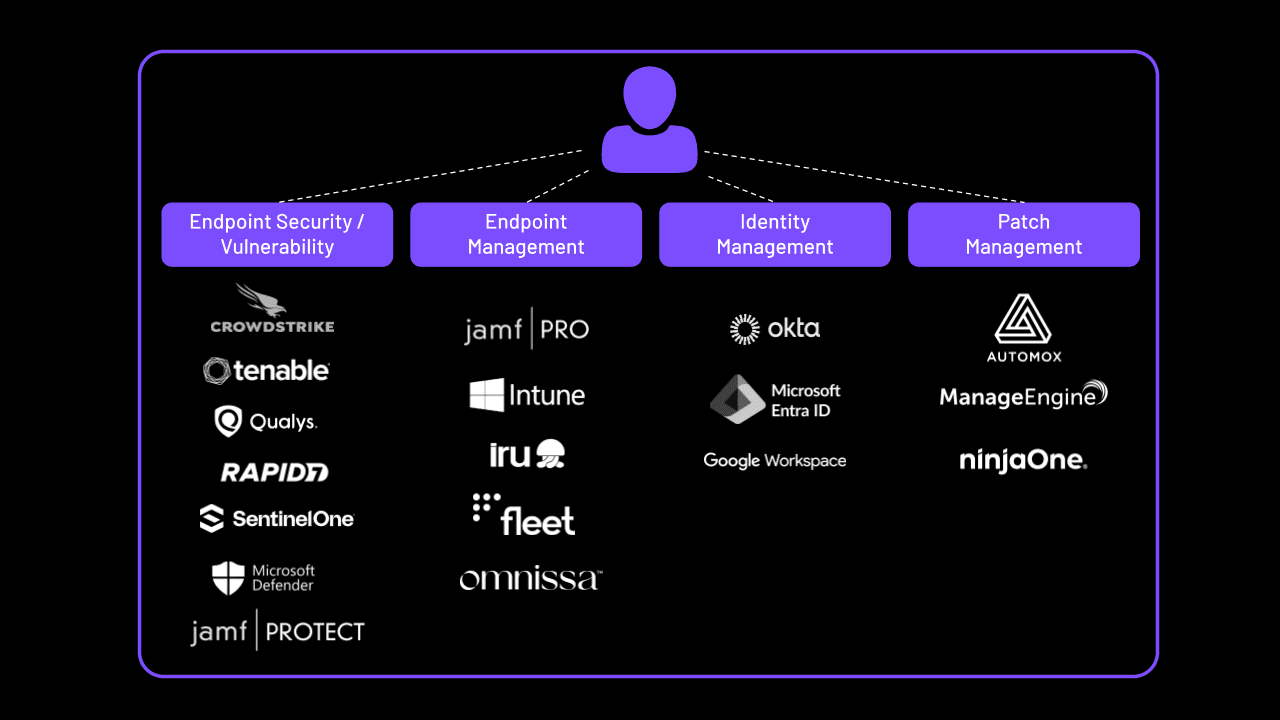
The result is a permanent search for risky users: missing security tools, inactive agents, unpatched vulnerabilities, unmanaged devices, and devices attributed to the wrong owner. By the time you have a clean picture, it is a week old.
The last mile: getting things fixed
This is where programs often stall, particularly when remediation spans Security, IT, and the employee.
In many organizations, Security reviews endpoint findings while IT manages devices and patching. When ownership is fragmented, remediation depends on manual handoffs and employee coordination, creating more opportunities for delay. Whether the employee needs to activate a tool, initiate a patch, upgrade the operating system, or reboot, risk remains open until the action is completed.
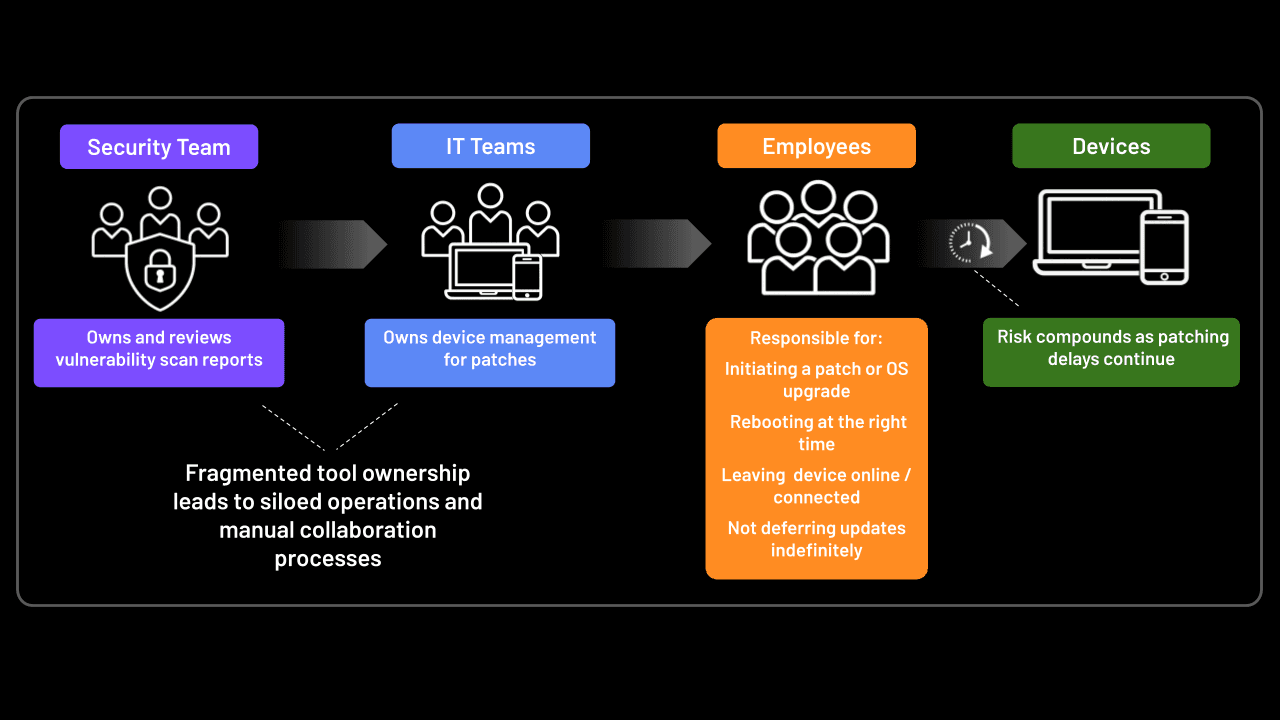
Visibility alone does not close this gap. A dashboard showing 400 open findings is not progress; it is a list of things nobody has done yet. Bridging the last mile of human risk is what separates an ESPM program that reduces risk from one that just measures it.
The questions ESPM lets you answer on demand
A working ESPM program means you can answer the hard questions before your audit team asks them:
Endpoint OS baselines. Which employees have not upgraded to the current corporate OS version? This is where macOS patch management tends to expose the gap between what MDM policy says and what the fleet actually runs.
Security tool coverage. Which users don’t have EDR and vulnerability agents running on their endpoint? Which agents are installed but haven’t checked in?
Device hardening. Which users don’t have firewall and disk encryption enabled? Has anyone disabled a corporate security setting?
User and device lifecycle. Which users are accessing resources from unmanaged devices? Are there active users tied to archived or inactive assets? Are any laptops assigned to the wrong employee?
Cloud and web security coverage. Which users have never activated, or have since disabled, their web security agent?
None of these should take a week and three exports to answer.
How Amplifier closes endpoint posture gaps
Amplifier is an agentic workforce security posture management platform. Think CSPM, but for your workforce and the devices they use. Endpoint posture is one of the surfaces it covers, alongside identity posture, SaaS security, and behavior.
The Amplifier platform ingests and normalizes data across your endpoint security, device management, vulnerability, and identity tools, then builds a live picture of who is protected, what is missing, and what stopped reporting.
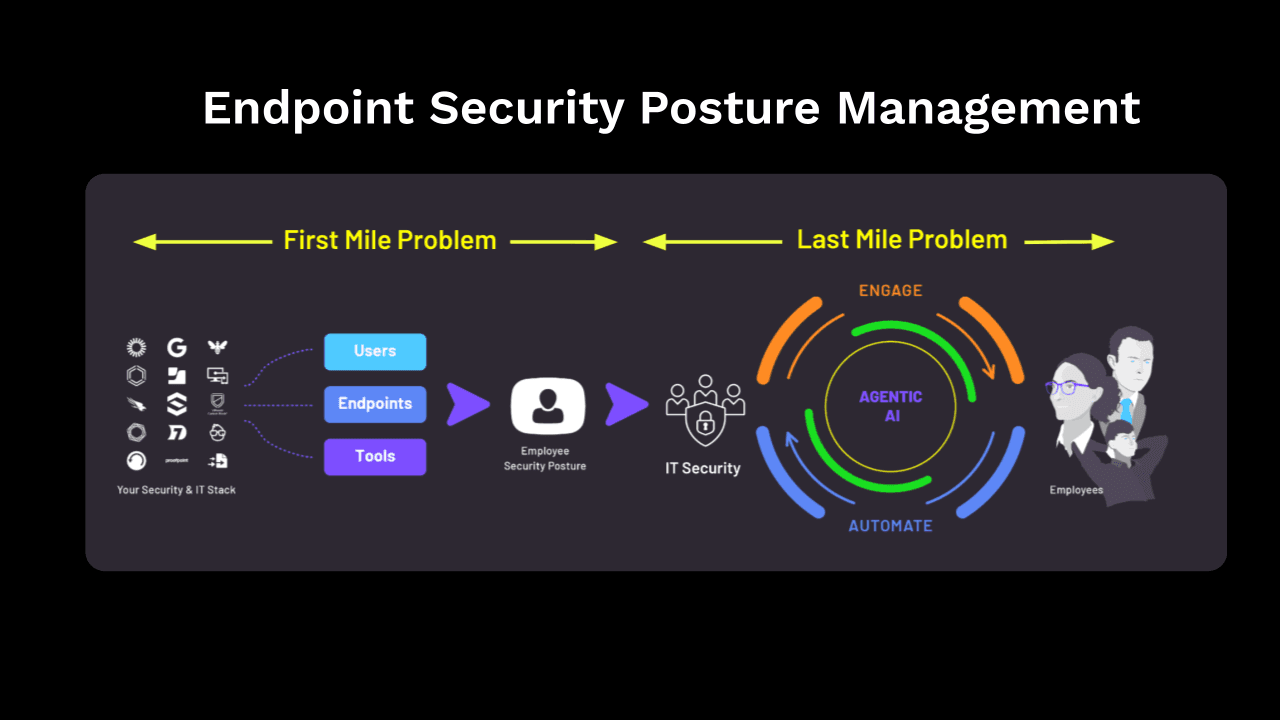
On the first mile, Amplifier continuously evaluates whether required controls are installed, active, and healthy on every attributed device. Security tooling coverage tracks EDR, DLP, MDM, and other required tooling across employees, devices, and business groups, and surfaces the silent gaps: missing agents, stale check-ins, disabled controls, and unmanaged assets. Offline EDR sensors are a classic example, because a sensor that stopped reporting can still appear installed or enrolled in inventory views that do not account for health and last-seen data.
On the last mile, Amplifier’s AI agents route identified gaps to the employee or owner best positioned to close them. Ampy, the AI security engineer, reaches employees in Slack or Teams with a two-way conversation: what the issue is, why it matters, and what to do about it, with an automated action attached and room to ask questions. Ampy can invoke and orchestrate actions across supported endpoint and patching tools, then verify whether the fix landed.
This is deliberately human-in-the-loop. Administrators control which engagements are launched, and employees participate when remediation requires action on their devices. Amplifier then checks the relevant source system to verify that the fix landed. That is the self-healing security model: the fix happens quickly, with people retaining control over the process.
The results show up in coverage numbers. Across early customer deployments, Amplifier reports EDR and DLP coverage increasing from 60% to 98% and outdated OS devices declining by 65%. In a separate enterprise deployment, more than 7,500+ endpoint vulnerabilities in under 30 days through AI-driven employee engagement rather than ticket-and-chase.
Amplifier is designed to complement your existing security stack. It can replace some manual reporting and ticket-driven workflows while extending the value of the endpoint, identity, and vulnerability tools you already use. It integrates with CrowdStrike, SentinelOne, Microsoft Defender, Jamf, Intune, Okta, Tenable, Qualys, Automox, and other tools commonly found in enterprise environments, including Jamf smart group compliance workflows for Mac fleets.
If you want to see what your endpoint posture actually looks like across your workforce, book a 20-minute demo.
Frequently Asked Questions
What is the difference between ESPM and EDR?
ESPM and EDR emphasize different questions about the same device. ESPM evaluates whether required controls are healthy, patches are current, protective settings are enabled, and unauthorized software is present. EDR primarily monitors runtime behavior to detect, investigate, and respond to threats. Broadly, ESPM aligns most closely with Identify and Protect, while EDR aligns most closely with Detect and Respond, although modern platforms often span several functions. The approaches are complementary: posture management reduces preventable exposure, while EDR helps identify and contain threats that reach the endpoint.
What is the difference between ESPM and vulnerability management?
Vulnerability management discovers, assesses, prioritizes, tracks, and supports the remediation of vulnerabilities across assets. ESPM broadens the endpoint view to include control health, configuration, software, ownership, and other posture signals that may fall outside a traditional vulnerability program. A device can be fully patched and still fail an ESPM check because its EDR sensor went offline six weeks ago. The practical distinction is one of scope: vulnerability management centers on weaknesses and exposures, while ESPM evaluates whether the broader endpoint control baseline is holding.
Is ESPM the same thing as device health or device security hygiene?
They are closely related, but their scope varies by vendor and organization. Device health, security hygiene, endpoint compliance, and endpoint posture all evaluate aspects of a device’s security state. ESPM applies the broader security-posture-management model to endpoints, typically emphasizing continuous assessment of configuration, control coverage, and remediation progress. A mature ESPM program connects findings to a remediation path, routes them to an appropriate owner, and verifies whether the underlying issue was resolved.
Can mid-market teams benefit from ESPM, or is it an enterprise tool?
Mid-market teams can benefit substantially from ESPM when lean staffing and fragmented tools make manual reconciliation and follow-through disproportionately expensive. Some teams still combine exports from multiple security and IT systems in spreadsheets or homegrown dashboards, producing a view that is difficult to maintain and quickly becomes stale. ESPM can automate correlation and employee follow-through, but the value depends on the organization’s existing tooling, staffing, integration coverage, and implementation requirements. For mid-market buyers, an important consideration is whether the platform works with tools they already own without requiring another agent on every endpoint.
Latest Blogs
Related Blogs & News
Watch