




In hundreds of conversations with security leaders, I keep hearing the same thing:
“I love the Amplifier product, but I don’t know who on my team should actually own and run it.”
They’re right.
Most companies do not have clear ownership of human risk inside the security team. That creates a first-mile problem.
Security teams already know the last-mile problem well: getting employees to follow through on security-related actions. Lasting behavior change requires employees to understand what to do, why it matters, and what action comes next.
But before you solve the last mile, you have to solve the first one.
That starts with a broader definition of human risk.
What Constitutes Human Risk?
Human risk is often treated too narrowly. Most teams default to awareness metrics because that is the part they have historically owned: training completion, phishing clicks, and policy acknowledgments. Those signals matter, but they are not the whole picture.
Human risk is broader than what an employee knows or whether they passed a module. It is the combined exposure created by three things: how people behave, how their identities are secured, and the workspace they use to get work done.
That means human risk is not just awareness. It includes risky actions that violate security policy, weak identity hygiene that makes compromise easier, and workspace conditions that increase blast radius when an employee device has an unpatched critical vulnerability or is missing a security tool .
The first area is awareness and behavior. This includes baseline security awareness training, phishing simulations, and policy communication. It also includes the behaviors that create exposure in the real world: clicking unknown links, sharing information through the wrong channel, bypassing security controls, storing passwords in the browser, ignoring policy, or routing around approved processes because security feels slower than the task at hand. This category should capture more than what employees were taught. It should capture what they actually do.
The second area is identity posture. An employee can complete every required training and still represent meaningful risk if their identity hygiene is weak. Poor credential hygiene, inconsistent MFA usage, low SSO adoption, unmanaged credentials, and overbroad access all increase the chance that one bad decision becomes a compromised account.
The third area is workspace posture. Employees do not operate in a vacuum. They work across devices, browsers, SaaS applications, and AI tools. Human risk rises when employees use non-compliant devices, unapproved SaaS applications, risky browser extensions, poor patching habits, or the newest AI tools that were never reviewed by security. The workspace shapes the consequences of unsafe behavior. It determines how far one mistake can spread.
If you only measure one of these areas, you are not measuring human risk holistically. You are measuring a slice of it.
Who Owns Human Risk Management?
This is where the first-mile problem starts.
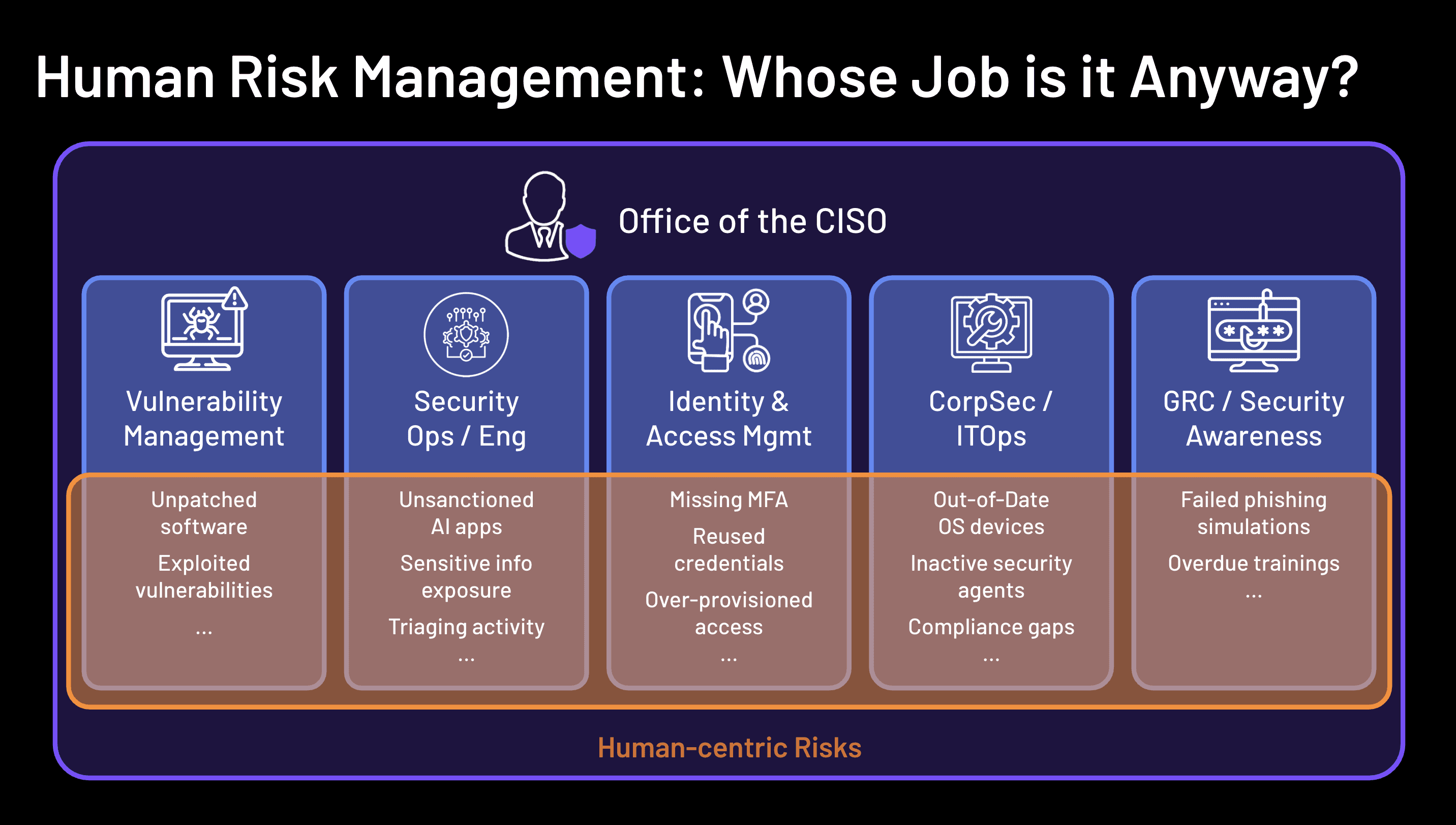
Human risk does not sit neatly in one cybersecurity function. It shows up across Identity and Access Management (IAM), vulnerability management, enterprise security, Security Operations, and its traditional, but often limiting, home in Governance, Risk, and Compliance (GRC), where most Security Awareness Training (SAT) tools live.
Because the problem is spread across so many silos, most organizations do not have a single source of truth for human risk.
That lack of ownership makes it hard to run a real human risk management program. It is one reason so many teams fall back to the basics: annual compliance training and phishing simulations that produce little more than click-rate metrics. The activity is visible. The actual risk is not.
This is not just a tooling problem. It is an operating model problem.
When awareness lives in one team, identity in another, endpoint hygiene somewhere else, and SaaS or AI exposure in yet another workflow, no one has the mandate to pull the picture together. No one owns the full lifecycle from finding to follow-through to resolution.
That is starting to change.
A new wave of leaders is stepping up to own human risk more holistically. In some organizations that is a dedicated Human Risk Management leader. In others it is a Security Awareness and Training program manager expanding beyond training and phishing, a Security Culture and Behavior lead, an Enterprise Security leader, a Security Program Manager, a Security Engineering leader, or a Corporate Security team with a broader charter.
These teams are looking beyond awareness content and asking a bigger question: how do we quantify, prioritize, and reduce employee-driven risk across the enterprise?
Once they solve the first-mile ownership problem, they can start solving the last mile.
Solving the Last Mile of Human Risk Management
Once a team has clear ownership of human risk, the next challenge is the last mile: getting employees to follow through.
This is where many programs stall. Security teams can identify weak identity posture, noncompliant devices, overdue training, risky browser behavior, unapproved SaaS, or unsafe AI usage. But identifying risk is not the same as reducing it. The work is done only when an employee takes the action that closes the gap.
Most programs still handle that with generic reminders, ticket queues, one-way notifications, and manual chasing. Those approaches create activity, but they rarely create consistent follow-through.
That is where Amplifier fits. Amplifier helps security teams turn risk findings into personalized, one-to-one employee engagements at scale so the right action actually gets completed.
The Future of Human Risk Starts with Ownership
The first-mile problem is easy to miss because most teams assume the hard part is the last mile. But the harder problem comes earlier: defining human risk broadly enough to reflect reality and assigning clear ownership for it.
Without that, human risk stays fragmented. Awareness lives in one workflow, identity posture in another, and workspace exposure somewhere else. The organization stays busy, but the full picture never comes together.
That is why a holistic human risk platform like Amplifier matters. It gives security teams a system of record for human risk by consolidating signals across awareness and behavior, identity posture, and workspace posture. It maps risk to individual employees, tracks findings through resolution, and helps teams manage human risk as an operational discipline rather than a training program.
The teams changing this are not waiting for the market to define the category for them. They are doing that work themselves. They are moving beyond the old boundaries of awareness programs, taking ownership of the broader problem, and building a more complete operating model for human risk.
These are the forward thinkers transforming human risk management. They are the ones creating clear ownership, connecting the right signals, and building a path to measurable risk reduction.
That is how the first mile gets solved.
And that is how the rest of the journey becomes possible.
Frequently Asked Questions
What constitutes human risk?
Human risk is the combined exposure created by employee behavior, identity posture, and workspace posture. It includes risky actions, weak credential and MFA hygiene, and devices, SaaS apps, and AI tools that can increase blast radius.
Who should own human risk management?
Human risk management should be owned by a leader or team that can operate across behavior, identity, and workspace risk. In many organizations, that is a human risk leader, security awareness leader, enterprise security leader, or security program leader with cross-functional authority.
What is the first-mile problem in human risk management?
The first-mile problem is the lack of clear ownership of human risk inside the security organization. Because human risk spans multiple domains, many companies lack a single owner, system of record, and operating model.
Latest Blogs
Related Blogs & News
Watch

