

Most MFA rollouts are an exercise in brute force. An army of helpdesk analysts whittle away at a pile of alerts, adoption rates trending up slowly but surely.
That is, up until you hit a structural wall somewhere around the 70-80% adoption mark. This plateau is hard to break because standardized workflows and procedures meet edge cases with enough friction to derail enrollment and remediation. The busy executive who can’t find time for MFA onboarding or the unreachable contractor operating outside the firewall become identity debt because IT teams don’t have the time or influence to chase them.
Many security teams write off this “last mile” of MFA adoption as unsolvable. But that’s because they’re looking at it as a technical or operational challenge, and not what it actually is: a user experience challenge. When the “fix” for a weak MFA factor is locked behind a 10-page instruction guide or a mandatory call with IT, security stops being policy and starts being a tax on productivity.
In 2026, the security teams successfully breaking this plateau are shifting the way they view MFA. Instead of trying to solve this last mile with helpdesk-led manual interventions, they are turning MFA adoption into human-centric, self-healing workflows. The end result? 100% MFA adoption, MFA gaps closed in real time, and all without a single Jira ticket.
This article looks at the new human-centric experience enabling security teams to crack the adoption plateau. See why evolving circumstances make this shift imperative for MFA rollouts in 2026 and how AI eases the burden on IT teams while also improving the user experience.
The State of MFA In 2026
To understand why the approach to MFA rollout needs to change, we first need to understand the challenges facing the space in the here and now.
In 2025, workforce MFA adoption reached 70%; however, the remaining 30% represents a catastrophic identity debt that threat actors are waiting to exploit. Furthermore, a significant 94% of organizations claim to have MFA, but only 10% actually enforce it across all applications.
This "MFA mirage" is precisely what attackers exploit. And that's why this gap has become the focus point of everyone from internal security teams to external regulators and insurers.
Mounting regulatory and compliance pressures
Across every sector, MFA is shifting from optional to necessary. Cyber insurance providers now require MFA across all user accounts as a baseline control. It is a prerequisite for policy renewal; without it, coverage becomes prohibitively expensive or simply unavailable.
Many organizations also face increased regulatory pressure. For example, under the NIS2 directive and emerging global frameworks, management bodies can be held liable for “gross negligence” in cybersecurity risk management. NIS2 doesn't explicitly mandate MFA, but national implementations guidance expects MFA for privileged access and recommends for all users accessing critical systems. Regulators want proof of remediation, not just policy.
Exemptions are the new zero days
Security teams are aware of MFA gaps but lack the resources to close them. They generate reports, send escalations, and create tickets, even as these unprotected accounts continue to represent real risk, potentially for months.
Security leaders live with these gaps because the chase required to close them leads to burnout. And sometimes, follow-up can even get contentious – if an executive pushes back because the process takes too much time, security leaders give them an exemption.
This is problematic because these exemptions are now zero day vulnerabilities, as the time to exploitation of MFA-related gaps continues to dwindle.
Spiraling financial consequences
The financial impact of MFA adoption gaps goes beyond regulatory fines. The average cost of a data breach reached $4.4 million in 2025, with compromised credentials as the leading initial attack vector.
When attackers can bypass your defences through a single unprotected account, your entire security investment becomes irrelevant. The partial adoption gives your team a false sense of security, but attackers only need one entry point. They actively scan for and exploit these gaps, targeting the users and accounts that lack additional authentication layers.
Shrinking attack windows
Cybercriminals now use agentic AI to discover vulnerabilities and automate the entire kill chain, from initial reconnaissance through data exfiltration.
These AI agents work around the clock, and they don't miss "shadow" applications or weak factors. And they’re also working at machine speed, so if your MFA remediation loop moves any slower, you’re going to be doing damage control instead of playing active defense.
Attackers aren’t just focused on the employees with weak MFA factors either. The MFA enrollment and remediation process itself has become a target, with attackers using interactive voice phishing to hijack MFA processes and gain access to employee devices.
The Human-Centric Approach to MFA Adoption
The conventional way of closing MFA gaps doesn’t scale. Your IT team is a finite resource, and using it to chase down noncompliant users is an inefficient use of their time. Even in the best case scenario, your IT team won't always be able to react at the speed required to close MFA gaps before they’re exploited.
What you need is a frictionless MFA workflow that works around the clock, guiding end users in real-time to enable MFA and remediate MFA gaps as they occur. At Amplifer, we call this workflow Silent Auth – a self-healing security model that turns users into distributed security admins by making it easy to fix their own gaps in seconds.
Here’s what this human-centric approach looks like:
Led by enablement, not education
MFA adoption efforts typically revolve around security awareness and scheduled communication. Security teams send out training that reinforces the importance of MFA along with guides for enabling it on various devices, and hope they follow through with the setup. If they don’t, the manual chasedown begins.
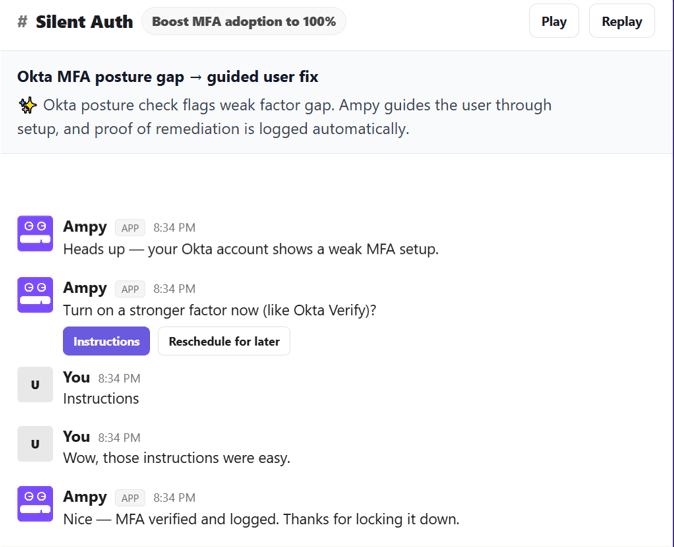
A human-centric approach focuses on engaging only the people at risk, and makes it easy to secure their account with a few clicks. Instead of everyone getting an annual reminder, a few people get a Slack message that walks them through the step-by-step process for their specific device and logs proof of remediation.
Contextual intelligence at scale
Traditional MFA rollouts treat all employees identically. This one-size-fits-all approach ignores individual employee context.
AI-driven, conversational workflows solve this by analyzing multiple contextual factors such as user role, device type, location, work patterns, technical proficiency, and even past security behavior. Agents can use this information to personalize engagements to the end user. It’s the difference between sending a link to PDF and sending the specific three steps for activating MFA on the user’s specific device and OS.
And when a user repeatedly postpones MFA setup, the AI doesn't just send the same reminder. It adjusts timing, changes messaging tone, escalates urgency appropriately, and eventually routes to human support if technical barriers are detected. This keeps IT and security teams in the loop without overwhelming them with alerts.
Turning risk signals into immediate action
The most effective MFA adoption strategy leverages integration with existing identity management platforms, using risk signals for creating a direct path from risk detection to user action. When an identity management system identifies an account without MFA, that signal can automatically trigger an engagement sequence. It can also flag other authentication issues like time drift, triggering immediate remediation workflows.
A user logging in from a new location might receive a prompt to enable MFA right then, while another user accessing sensitive data for the first time could be guided through MFA setup as part of that access flow. Self-service remediation paths put control in users' hands while maintaining security oversight.
Achieving 100% MFA Adoption: A Practical Framework
Moving from 70% to 100% MFA adoption requires a systematic methodological approach that addresses both technical gaps and human behavior. This framework includes four actionable steps transforming MFA from a stalled initiative into a sustained security posture.
Step 1: Map your current state
Start by identifying coverage gaps across users and devices. Which employees lack MFA? Which of their devices authenticate without it? Are there patterns by department, role, or location? The segmentation helps you understand whether you're dealing with isolated cases or systemic issues.
Next, understand which tools and applications lack MFA coverage. Legacy systems often lack MFA capabilities entirely. Cloud development environments might use alternative authentication. Each gap represents a potential risk.
The most sophisticated approach correlates identity risk with device posture. Someone accessing sensitive data from an unmanaged device needs immediate attention. This contextual understanding allows you to prioritize remediation efforts effectively.
Step 2: Automate the engagement layer
Automate the entire engagement cycle from initial notification through resolution verification to achieve 100% MFA adoption. Build a personalized workflow that adapts to users' specific environment, role, and technical context. If someone indicates they need to schedule MFA setup for later, the system should allow that while ensuring follow-up. If they report technical difficulties, the workflow should route them to appropriate support resources.
Create seamless exception and escalation paths. Automated systems should handle routine cases independently while recognizing scenarios that require human intervention and escalating accordingly. If an employee disables MFA, travels without their authentication device, or attempts to access systems from an unconfigured device, automated engagement should trigger within minutes.
Step 3: Track more than MFA adoption
Metrics like percentage of users enrolled in MFA by population, coverage by application and access pathway, and exemption count are baseline metrics that help show shifts in MFA rollout. But you can and should go beyond these metrics if you want to truly measure the impact of your MFA rollout.
Monitor mean time to resolution (MTTR) improvements. How long does it take from identifying an MFA gap to closing it? Those with automated engagement see resolution in days or even hours, while organizations with manual processes take weeks.
You could also look at metrics like helpdesk deflection – how many MFA gaps are the AI-led workflows closing and how many are your helpdesk still handling? Your security team wins if you hit 100% adoption while also reducing identity-related ticket volume by 40%.
Step 4: Maintain continuous posture and audit-ready reports
Maintaining 100% MFA adoption ensures continuous protection for your organization. Monitoring new users and devices to ensure MFA requirements apply from the moment someone joins your organization or provisions new hardware.
An automated workflow that logs proof of remediation automatically and makes it accessible with real-time dashboards helps you demonstrate success and produce audit-ready reports that show current coverage, historical trends, and resolution rates.
How Silent Auth Drives 100% MFA Adoption
Amplifier's Silent Auth workflow for MFA adoption and remediation is a closed-loop system that does the dirty work your helpdesk shouldn’t have to do in the first place. Here’s how it works:
Amplifier pulls risk signals from Identity and Access Management (IAM) tools into a unified view of human risk for each employee and team, looking for gaps that create toxic attack paths.
When posture checks find issues like weak MFA setup, it triggers Amplifier’s AI Security Engineer Ampy to jump into action, executing predefined workflows like Silent Auth.
Ampy engages high-risk end users in real time to walk them through the steps of enabling a stronger factor, based on the specific device and application being used.
Amplifier verifies the new posture, records proof of remediation, and clears the risk, all without opening a single ticket.
What makes this human-centric approach led by Ampy so effective is its focus on helping end users finish their MFA deployment quickly and get back to work. Ampy is essentially acting as an identity concierge, providing a curated, 30-second path for remediating the issue. No scheduling a call with IT, no digging through portals and emails looking for guides, just a quick fix that can be executed in the time it takes to read a notification.
Amplifier customers are already seeing the results. One customer saw a 40% jump in MFA adoption after implementing the Silent Auth workflow within days of deployment. This didn’t just improve security posture, it also spared the IT team from months of manual follow-up.
Time To Close Security Gap With 100% MFA Adoption
In 2026, organizations stuck at an MFA adoption plateau don’t just have a security issue – they have a legal liability. It’s imperative to address this gap, not only to thwart attackers but also to demonstrate your security posture to insurers and regulators.
It’s time to address the last mile of MFA rollout and adoption by deploying human-centric workflows. AI Security Engineers like Ampy and human risk management platforms like Amplifier enable security teams to engage employees when gaps are surfaced, guide them through remediation, and verify completion, completely autonomously and in real time.
FAQ
What is the biggest mistake in MFA enrollment campaigns?
The biggest mistake is failing to enforce after the final reminder. If no consequence follows the deadline, future security mandates lose credibility. Consistency matters more than tone.
Is it better to send more frequent reminders over a shorter period?
Higher frequency increases urgency but also raises fatigue and resentment. Using AI-driven conversational workflows enables precise, personalized outreach that’s more effective than high frequency communications.
What metrics should we track beyond enrollment rate?
Track time-to-enrollment distribution and help desk ticket volume. These reveal whether messaging or usability is the constraint. Be wary of metrics like training completion rates that do not indicate compliance.
Who should MFA enrollment reminders come from?
Traditionally, early reminders come from IT or security operations and the final escalation from a senior leader. Conversational workflows guided by an agent can help shift that dynamic, playing the role of a concierge instead of a hall monitor.
Latest Blogs
Related Blogs & News



Watch