

The fastest 25% of intrusions now reach data exfiltration in 72 minutes, down from 285 minutes the previous year. Ransomware actors aren't slowing down. They're accelerating while organizations' security programs are unable to keep pace to contain the risk. The global cost of ransomware is estimated to reach $275 billion annually by 2031, driven by downtime, data loss, recovery efforts, and lost productivity, not just ransom payments.
Ransomware actors are increasingly exploiting firewall vulnerabilities as initial access vectors, making endpoint devices common entry points. Manual response workflows with manual triage, assigned tickets, and delayed escalations are exactly where ransomware spreads.
Endpoint isolation is fast becoming an effective deterrent against ransomware attacks. It is the new non-negotiable in ransomware defense, something security teams can implement without disrupting their entire operations.
Ransomware Containment: Speed Is The Decisive Variable
Ransomware doesn't wait for tickets to be assigned or approvals to be granted. Threat actors know most organizations rely on layered detection, ticket-based workflows, and human validation before containment actions are taken. They’re exploiting that delay. The response window has shrunk, and you now have to respond in minutes.
The New Attack Timeline
Compressed attack lifecycle
Previously, ransomware attackers would spend days or weeks inside a network before triggering encryption, giving defenders at least some window to catch unusual activity. However, an analysis of more than 750 major incident response engagements across 50+ countries indicates that the attack lifecycle is rapidly compressing.
The fastest ransomware case documented in 2025 involved Akira ransomware, which progressed from breach to full encryption in just three hours. At that pace, a threat detected at 9 AM could already have encrypted critical systems before the organizations set their response systems in motion.
AI-enabled automated attacks limits response window
Threat actors are using Artificial Intelligence(AI) to attack, giving organizations little time to respond. AI-enabled automated attacks shift ransomware strategies from linear, multi-step processes to simultaneous, machine-speed operations that cover reconnaissance, lateral movement, and extortion in parallel.
These AI agents can scan targets, move laterally within minutes, and handle data exfiltration concurrently, necessitating instant endpoint isolation to defend against shortened attack timelines.
Firewalls Are No Longer The Shield
Porous firewall
Attackers are exploiting firewalls and edge devices through unpatched software vulnerabilities or compromised accounts. These systems often run exposed services, lag in patching, and operate with elevated trust inside the network. Once compromised, they provide a high-value foothold.
The traditional assumption that the firewall will stop it no longer holds, necessitating a quick response.
Outdated perimeter-based security
Perimeter-based security is outdated. Once attackers breach the network via endpoints, they move laterally using legitimate IT tools such as remote monitoring software, administrative protocols, and trusted SaaS integrations. It enables them to avoid triggering detection systems that are calibrated to look for obviously malicious behavior.
With authenticated access becoming the primary vehicle for post-breach movement, the new battlefield is within the network, at the endpoint level.
Limitations In Restricting The Lateral Movement
Manual workflows delay containment
Lateral movement is when an attacker on a compromised device breaks containment and pivots to adjacent systems, escalating privileges, and ultimately reaching the assets they're after.
"96% of incidents involving lateral movement ended with ransomware deployment." — Barracuda Managed XDR Global Threat Report 2026
The moment lateral movement is detected, the clock has already been running. However, most teams still rely on manual triage to detect this. A manual workflow leads to delays in resolution, with resolution times stretching into hours, and those hours are exactly what attackers need. The security team should quickly disconnect compromised endpoint devices, as they can become weapons for lateral movement.
Broad attack surface increases breach vulnerability
Attackers operate across multiple attack surfaces simultaneously, such as endpoints, networks, cloud environments, SaaS platforms, and identity layers. The attack surface is broad and interconnected. A single unmonitored device, a laptop with a disabled security agent, or an endpoint that hasn't been patched in 60 days is enough to give an attacker an entry point to breach your network and move laterally undetected for a long time.
Monitor endpoints continuously and consistently to ensure any compromised devices are instantly disconnected from the network, without giving attackers much leeway to deploy ransomware.
Ransomware Defense Strategy To Promptly Contain The Threat
Effective ransomware defense requires comprehensive visibility across the entire stack. The visibility should enable your security team to correlate signals from identity providers, endpoint management tools, EDR platforms, and vulnerability scanners, and leverage data for coordinated automated action. Attackers rapidly traverse your network, and if your ransomware defense strategy isn’t designed to outpace them, you risk falling prey to their demands with median ransomware payment estimated to be $1.15 million.
3 Phases of Ransomware Defense
An effective ransomware defense program operates across three distinct phases.
Protection
It is the first line of defense, focusing on reducing the "attack surface" available to hackers. This involves a combination of technical barriers and human vigilance designed to stop hackers at the first point of entry and prevent them from gaining access to the network. It includes the controls such as patch management, MFA enforcement, least-privilege access, and continuous vulnerability scanning. According to the Palo Alto Networks Unit 42 Global Incident Response Report, more than 90% of breaches were enabled by preventable gaps such as misconfigurations, inconsistent controls, and excessive identity trust.
Detection and Containment
The detection and containment phase operates on the principle that no perimeter is 100% foolproof. This phase leverages real-time signal and behavioral analytics to identify signs of active intrusion, such as unusual file encryption or unauthorized data transfers. In this phase, speed is critical to reduce dwell time, which is the time period an attacker spends in the system before launching the ransomware. This phase is where most organizations lag, unable to intercept the threat before it reaches critical mass.
Recovery and Remediation
The final step focuses on neutralizing the attacker's leverage and ensuring business continuity. When an attack occurs, the priority shifts to isolating infected segments to prevent lateral spread and then performing a clean restoration of systems.
The organization uses its pre-planned incident response plan to rebuild from immutable data backups, limiting operational disruption and avoiding financial loss. An updated risk-scoring methodology and employee education ensure that the same vulnerability or behavior isn't exploited again.
Key Elements Of An Effective Ransomware Defense Strategy
An effective ransomware defense requires more than isolated security controls. It should move beyond a reactive posture by transitioning from a "perimeter-first" mindset to a resilience-first framework. A coordinated strategy that reduces exposure, limits attacker movement, and enables rapid recovery, ensuring that even if a breach occurs, the impact is minimized.
Rapid Detection And Instant Containment
Detection must be paired with immediate containment. Advanced monitoring tools identify malicious behavior, but endpoint isolation and network segmentation are essential to stop lateral movement. Automated, policy-driven containment minimizes blast radius, reduces dwell time, and prevents attackers from escalating privileges or encrypting additional systems across the environment.
Defining Relevant Metrics
Mean Time to Detect (MTTD), the average time it takes for your security team to identify a security threat, is a baseline expectation at this point. A more effective metric is now Mean Time to Contain (MTTC), which is the average time, from detection to isolation, your security team takes to stop a threat from spreading.
Resilient Backups
Immutable, regularly tested backups ensure business continuity when prevention fails. Your recovery plans should include clear restoration priorities, timelines, an incident response plan, defined recovery time objectives (RTOs), and recovery point objectives (RPOs). Preparedness enables you to ensure business continuity and transforms ransomware from an operational crisis into a manageable recovery event.
Key Factors Ransomware Defense Programs Fails
Even well-intentioned ransomware defense programs can fail to perform as intended. The issue is not a lack of tools or technology but structural weaknesses in execution, containment, and recovery. Understanding the key leading to failures is the first step toward building resilience that can withstand real-world attacks.
Defense Tools Operate in Silos
Detection has improved significantly with the proliferation of EDR and XDR tools. Most organizations have strong individual tools such as EDR, SIEM, and endpoint management, but these tools don't act in concert. A malware signal detected in one tool doesn't automatically trigger a response in another. An identity alert doesn't update the endpoint risk score. A lack of coordinated response let attackers exploit every seam between them.
As a result, containment is delayed, allowing attackers to move laterally within the organization's network. The containment that actually determines how much damage ransomware causes is where organizations' defense programs critically fail.
The Human Firewall and Social Engineering Gap
The neglected human aspect compounds the problem, as employees whose devices are compromised are typically the last to know, and they're never part of the response. Ransomware programs often fail because security awareness training is treated as a periodic compliance checkbox rather than a continuous culture of vigilance.
When employees are not equipped to recognize sophisticated phishing attacks, they inadvertently provide the high-level access attackers need to bypass security controls. They're bystanders, which means a potential layer of rapid, contextual response is being left entirely untapped.
Inadequate Recovery Readiness
Ransomware defense often collapses when organizations discover their "safety net" is compromised. Many organizations assume backups guarantee resilience, but fail to test restoration processes under real-world conditions, undermining recovery efforts during ransomware attacks.
Backups may be outdated, misconfigured, or accessible to attackers. Modern attackers specifically hunt for and delete online backups or shadow copies before deploying the encryption payload. Without validated recovery plans and defined RTO and RPO targets, recovery becomes challenging and prolonged during an actual ransomware event.
Why Endpoint Isolation Is Non-Negotiable
Endpoint isolation is a containment measure that immediately disconnects a compromised device from the network to prevent lateral movement. The isolation blocks the device's ability to communicate with other systems, share files, or spread malicious code. The device is not completely shut down and remains powered, to stop the attacker's spread while preserving forensic visibility for investigation and remediation.
Traditional isolation can occur directly at the network infrastructure level with administrators disabling the firewall rule or switch port associated with the compromised device.
Network Access Control systems enforce isolation at the network layer, while in Software-Defined Networking (SDN) environments, isolation is implemented through dynamic policy changes at the controller level.
In organizations with advanced security implementation, Endpoint Detection and Response (EDR) tools isolate devices by pushing commands through the installed agent.
Isolation Must Happen Before Encryption, Not After
The ransomware kill chain follows a predictable sequence: initial access, privilege escalation, lateral movement, data staging, and then encryption. Endpoint isolation is effective if it interrupts this chain before encryption begins. Once encryption is underway, isolating the device limits the damage but you lose access to the encrypted data.
Teams that rely on manual review before triggering isolation are inadvertently making the decision after encryption has started.
Automate Containment To Isolate Endpoint At The Detection Phase
EDR tools, SIEMs, and endpoint management platforms are reasonably good at detecting a malware signal and generating alerts within minutes. The failure isn't detection but the subsequent processes. The alerts get lost in the bureaucratic process of getting converted into tickets, which are assigned to analysts who review, confirm, and escalate. Finally, the endpoint is isolated after substantial time has elapsed since signals were first detected.
The tools that detect threats are disconnected from those that respond to them. The bridge between these two distinct tools is the human response workflow, which introduces latency that attackers exploit. Automate containment actions to reduce response time from hours to minutes.
Engage Employees For A Coordinated Response
Automated isolation ensures timely mitigation, but indiscriminate endpoint isolation creates its own risks. Cutting a device off from the network mid-transaction can corrupt active workflows, break time-sensitive processes, and risk alienating employees, an untapped response resource.
Engage employees by clearly communicating why their device is being contained, what they need to do, and what happens next. Employees become part of containment and isolation turns into a collaborative effort. Human context accelerates investigation, reduces false positives, and builds the kind of security instincts that training modules never deliver.
How Malware Solo Contains Endpoints in Minutes
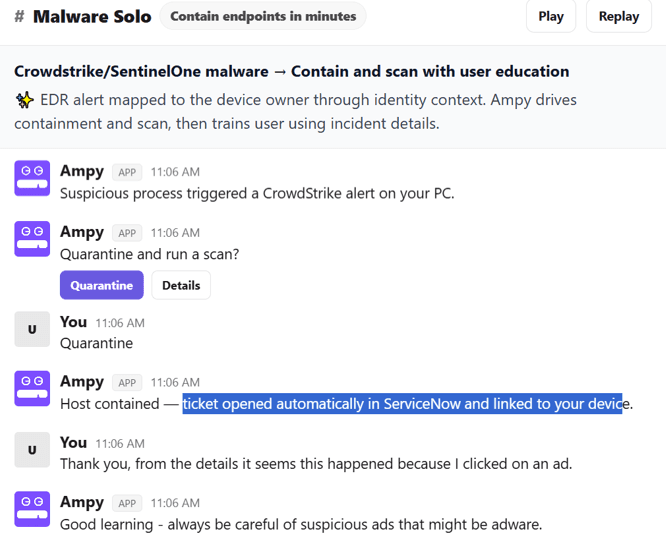
Malware Solo is Amplifier Security's purpose-built automation that converts malware detection signals into immediate, guided endpoint containment. When Amplifier AI agent Ampy detects a malware signal through integration with other security tools like CrowdStrike, Jamf, or Microsoft Defender, it alerts the device owner and triggers an employee engagement workflow.
From Signal to Isolation Without the Ticketing Overhead
Malware Solo works within your existing stack. It connects to the endpoint management and security tools your team already uses and turns their signals into employee action. The affected device owner receives a real-time notification from Ampy which also automatically opens a ticket linked to the device in the organization IT system such as ServiceNow.
Human-in-the-Loop
Malware Solo treats employees as an essential layer of the response. Employees can take immediate action, request a legitimate-use exception with context, or schedule containment after a critical deadline, all within the same workflow. The security team gets full visibility into every decision and its outcome, updated in real time.
Another advantage is that every containment event becomes a micro-training moment. Employees learn why their device was flagged, what the risk was, and the behavior to change going forward. Over time, this builds genuine security habits, something that training modules fail to inculcate.
Act Before The Encryption Starts
With attacks compressing from days to hours, the era of slow containment is over. Effective defense today requires automated isolation at the speed of detection, employees engaged as active participants, and tools that act in concert rather than in silos. Isolating a compromised endpoint before it becomes a network-wide incident is key to limiting ransomware damage.
Amplifier Security's Malware Solo is a custom-built AI tool that converts malware signals into guided, verified endpoint containment without the ticketing overhead. The question isn't whether your organization will face a ransomware attack. It's whether you'll contain it before the encryption starts.
Latest Blogs
Related Blogs & News



Watch